Mobile User Acquisition Strategy: A Practical Playbook for Installs That Retain
The metrics, measurement, channels, creative testing and 90-day plan behind a mobile user acquisition strategy that scales installs that actually stick.

Buying installs is easy. Buying installs that are still opening your app a month later — at a cost the business can sustain — is the real job of mobile user acquisition. The difference rarely comes from one clever trick. It comes from getting a handful of fundamentals right, in the right order.
This playbook walks through a practical mobile user acquisition strategy: the metrics to manage, the measurement to put in place before you spend, how to choose channels and creatives, how to protect your budget from fraud, and a 90-day plan to go from first test to confident scale.
1. Manage the metrics that predict growth
Cost per install is the number everyone quotes, but on its own it says very little about whether a campaign is working. Track these together:
- CPI (cost per install) — what each new user costs to acquire.
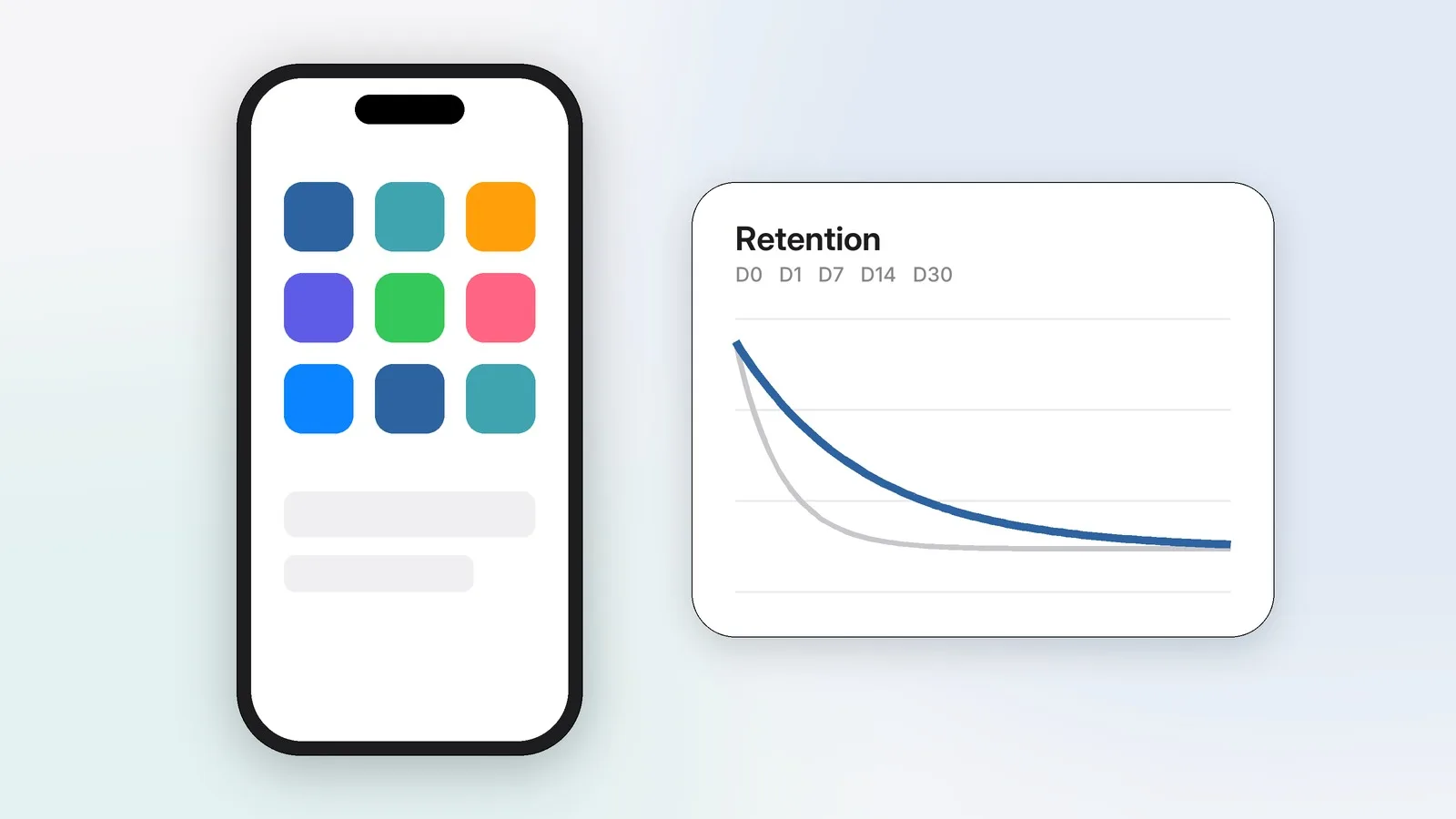
- Retention (D1, D7, D30) — the share of a cohort that comes back on day 1, day 7 and day 30. It is the earliest reliable signal of user quality.
- Activation rate — the share of new users who complete the first meaningful action: finishing onboarding, creating an account, completing a level.
- ROAS by cohort — revenue generated by a cohort divided by what it cost, measured at fixed points such as day 7, 30 and 90.
- LTV and payback period — how much a user is expected to be worth and how long it takes to recover their acquisition cost.
The point is to judge every source, campaign and creative on quality-adjusted cost. A source with a slightly higher CPI and much better retention is almost always the better buy.
2. Get measurement right before you spend
Optimization can only be as good as the data feeding it. Before scaling any budget:
- Integrate a mobile measurement partner (MMP). It attributes installs and in-app events to the campaigns that drove them, and gives you one consistent source of truth across networks.
- Map your key events. Agree on a short list — registration, tutorial complete, first purchase, subscription — and make sure each fires reliably on both platforms.
- Send events back to your partners. Postbacks let bidding algorithms optimize toward valuable users rather than cheap installs.
- Plan for privacy-preserving attribution on iOS. Apple’s attribution frameworks report conversions in aggregated, delayed form, so set up conversion-value mapping deliberately and judge iOS campaigns on cohort trends rather than user-level detail.
- Set up deep links. Sending users straight to the right screen — not just the home screen — lifts activation, especially for re-engagement campaigns.
3. Choose channels deliberately
Each channel plays a different role. Strong programmes use several, sized according to the results each delivers.
Self-serve platforms
The large app-install platforms offer enormous reach and powerful automated bidding. They are usually the backbone of a UA plan, but they reward strong creative and clean event data, and they can become expensive at scale in competitive categories.
In-app networks and DSPs
Rewarded video, playable, interstitial and native placements inside other apps and games reach users at the moment they are already engaged on their phone. Programmatic buying through DSPs adds control over supply, bidding and targeting across exchanges.
Connected TV
CTV builds awareness on the biggest screen in the home and can drive installs directly through QR codes and companion targeting. It works best alongside performance channels, not instead of them.
Retargeting and re-engagement
Bringing lapsed users back is often cheaper than acquiring new ones. Re-engagement campaigns with deep links and personalized creative can lift retention curves that acquisition alone cannot fix.
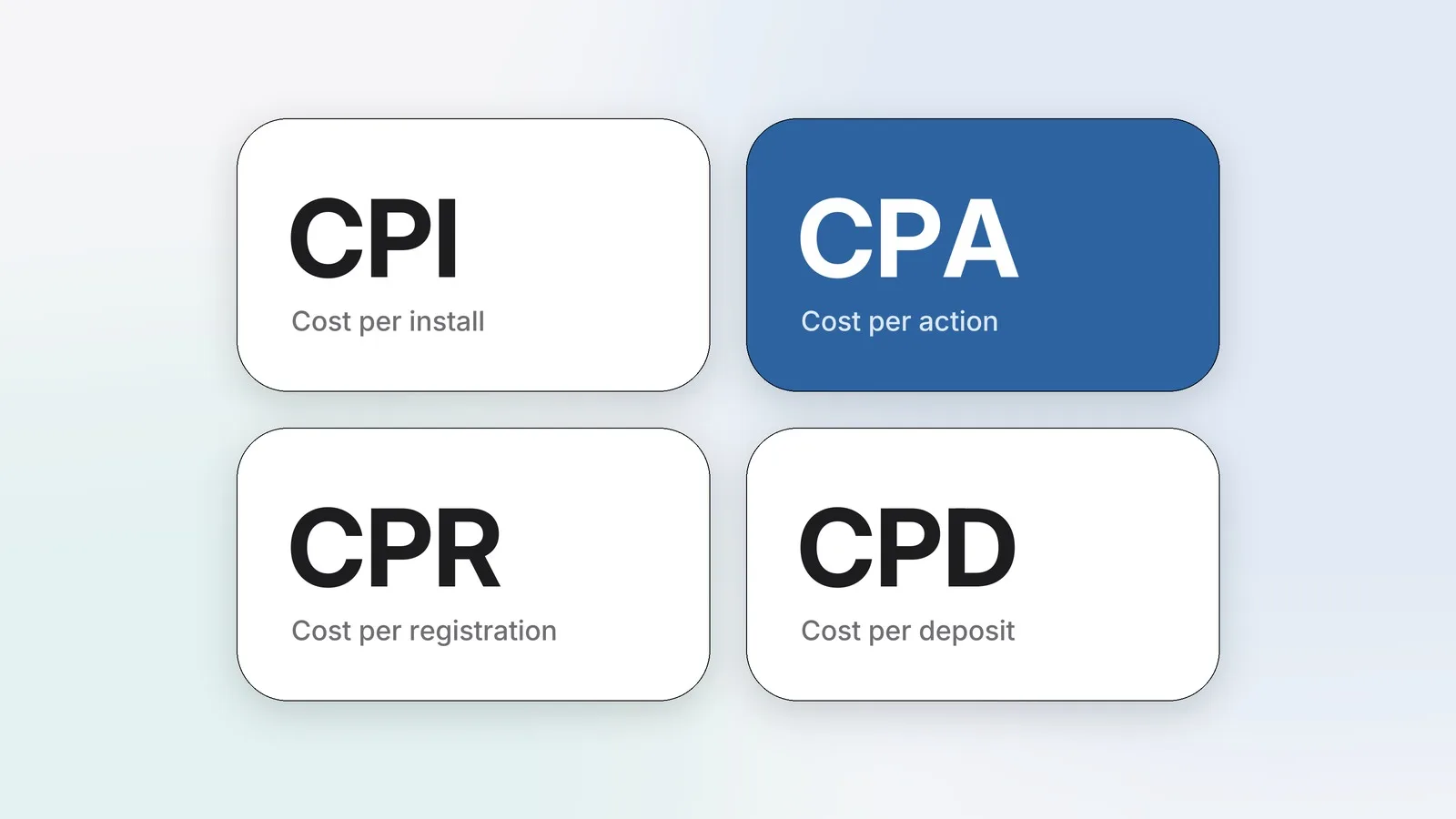
Not sure what each pricing model means for these channels? Our guide to CPI vs CPA vs CPR vs CPD explains how to choose.
4. Treat creative as your biggest lever
When targeting is increasingly automated, creative is where you still have the most influence over results. Build a repeatable testing system rather than relying on one hero ad:
- Test concepts before variations. Different messages and hooks first; colours and button text later.
- Lead with the core experience. The first seconds should show what makes the app worth installing.
- Match the format to the placement. Rewarded video for engaged gamers, playables for try-before-install, native for considered products. You can see each format in action in our interactive ad format demos.
- Refresh on a schedule. Creatives fatigue. Plan a steady pipeline instead of reacting when performance drops.
- Judge creatives on downstream quality, not just click-through rate. An ad that over-promises lifts installs and hurts retention.
5. Optimize for retention, not just installs
- Bid on events, not installs, wherever your volume allows it.
- Read results by cohort. Compare users acquired in the same week from different sources, so you are comparing like with like.
- Prune sources on quality. Cut or reduce placements whose users do not activate, even if their installs look cheap.
- Fix the first session. Onboarding problems show up as poor day-1 retention across every channel at once. That is a product issue, and no amount of media optimization will solve it.
The cheapest install is the one you never have to buy twice. Retention is what turns acquisition spend into an asset.
6. Protect your budget from fraud
Mobile UA attracts fraud because installs are easy to fake and valuable to sell. The most common schemes include click spamming, click injection, SDK spoofing and device farms. Practical defences:
- Use your MMP’s fraud protection and review rejected installs regularly.
- Watch for suspicious click-to-install time patterns and users with no post-install activity.
- Pay on validated events, and agree up front that fraudulent installs are not billable.
- Work with partners who give you source-level transparency.
For a deeper look at detection and prevention, read our guide to stopping invalid traffic.
7. A 90-day plan from test to scale
Weeks 1–2: foundations and first tests
- Confirm MMP integration, event mapping and postbacks.
- Set target CPI and quality guardrails from your unit economics.
- Launch controlled tests on two or three channels with several creative concepts.
Weeks 3–6: learn and optimize
- Read early retention and activation by source and creative.
- Shift budget toward winners; pause sources that fail quality checks.
- Move bidding toward deeper events as volume grows.
- Start a second wave of creative based on what worked.
Weeks 7–12: scale with control
- Increase budgets on proven sources in steps, watching cost and quality at each step.
- Add channels such as CTV or new in-app supply to find incremental reach.
- Launch re-engagement for lapsed users.
- Review cohort ROAS against payback targets and set the next quarter’s plan.
Common mistakes
- Scaling before measurement and postbacks are in place.
- Comparing channels on CPI alone.
- Running the same creatives for months.
- Treating fraud as someone else’s problem.
- Expecting media to fix a weak first-session experience.
Frequently asked questions
What is a mobile user acquisition strategy?
It is the plan for how an app attracts new users efficiently: which metrics define success, which channels and creatives to use, how budgets are allocated and tested, and how quality and fraud are controlled as spend grows.
How much should we spend on a first UA test?
Enough to reach meaningful volume on each source and creative you test — usually a few hundred installs per cell — so that differences in retention are real rather than noise. A partner should size the test with you based on your target CPI and markets.
Should we optimize for installs or in-app events?
Start where your data volume allows, then move to in-app events as soon as you can. Event-based optimization consistently finds better users than install-only bidding.
How long does it take to see results?
Early quality signals such as day-1 and day-7 retention arrive within the first two weeks. Revenue-based metrics like 30- or 90-day ROAS naturally take longer, which is why a staged 90-day plan works well.
Ready to scale installs that stick?
SkyPlay Media runs mobile user acquisition and retention campaigns on CPI and CPA across in-app, programmatic and connected TV inventory, with AI-driven optimization, fraud prevention and real-time reporting. Share your goals in a campaign brief and we will come back with a test plan built around your KPIs.
SkyPlay Media is a results-driven performance marketing and ad-tech company helping advertisers and app developers grow through data-driven user acquisition and retention.
Let’s build growth, powered by performance.
Talk to a specialist about your goals — we reply within one business day.