CPI vs CPA vs CPR vs CPD: How to Choose the Right Performance Pricing Model
Compare the four main performance pricing models — how each works, when to use it, and how to set a target price from your own unit economics.

Choosing a pricing model sounds like a procurement detail. In practice, it decides what your media partner optimizes for, how much risk you carry and how fast a campaign can scale. Pick a model that pays for the wrong event and you can hit every target on paper while the business standing behind the campaign quietly loses money.
This guide compares the four most common performance pricing models — CPI, CPA, CPR and CPD — explains when each one fits, and shows how to set a target price from your own unit economics rather than from a benchmark someone quoted on a call.
CPI vs CPA vs CPR vs CPD at a glance
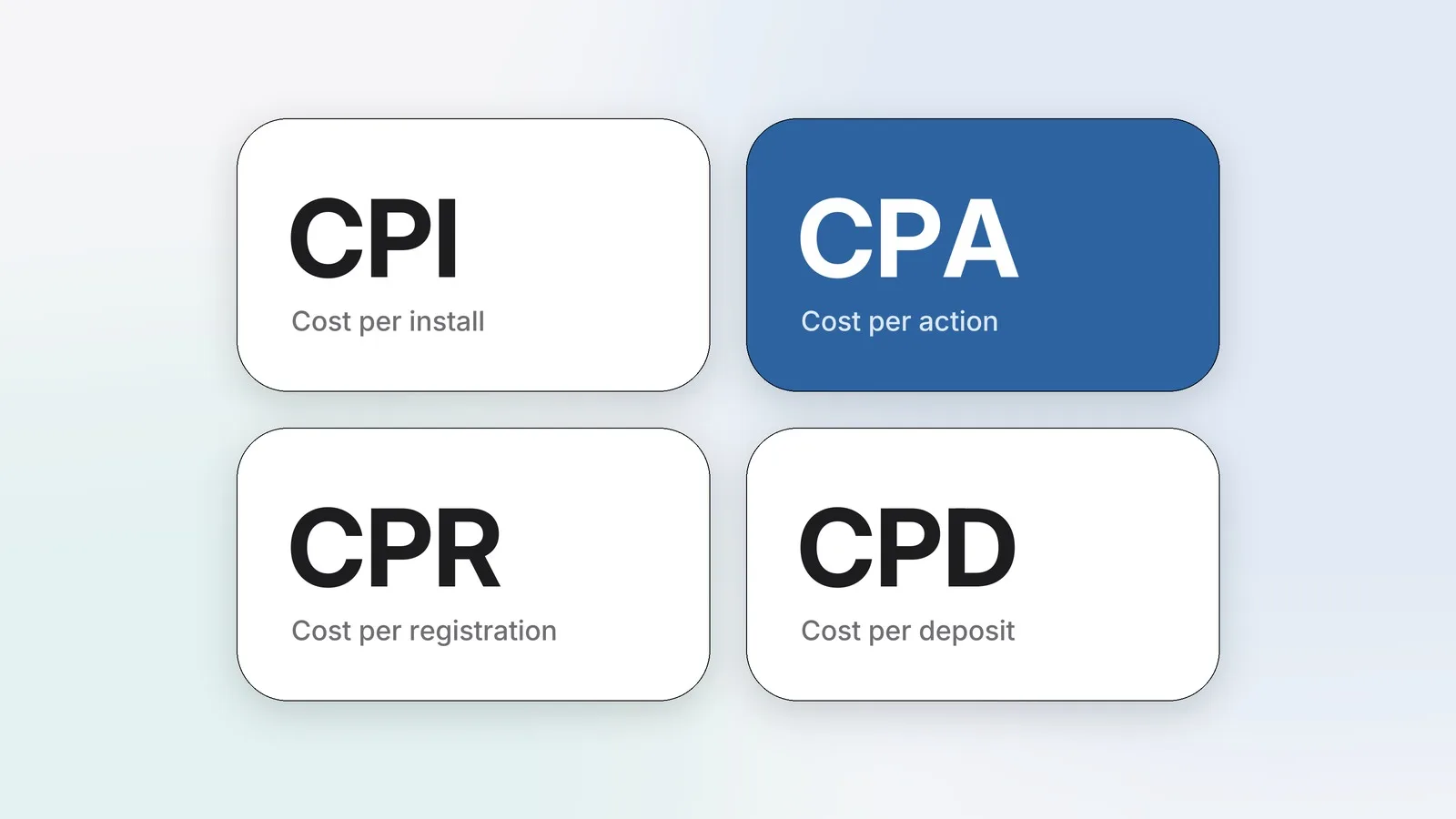
All four are outcome-based: you pay when something specific happens, not for impressions or clicks. The difference is where in the funnel that payment is triggered.
| Model | You pay when… | Best for | Main thing to watch |
|---|---|---|---|
| CPI — cost per install | A user installs and opens your app | App launches and scaling user acquisition | Install quality and retention |
| CPA — cost per action | A user completes an action you define | E-commerce, subscriptions, utilities, games with clear in-app events | A precise, trackable definition of the action |
| CPR — cost per registration | A user creates a verified account | Lead generation, marketplaces, SaaS, account-based funnels | Fake or low-intent sign-ups |
| CPD — cost per deposit | A new user makes a first deposit | Fintech, trading and other deposit-driven products | Compliance, verification and longer conversion windows |
What is CPI (cost per install)?
CPI is the price you pay each time a user installs your app as a result of a campaign. It is the default model for mobile user acquisition because the install is the first event every app can measure reliably through a mobile measurement partner (MMP).
The formula is simple: CPI = media spend ÷ attributed installs.
When CPI works well
- You are launching an app and need volume to learn which audiences and creatives work.
- Your monetization is spread across many events (ads, small purchases), so no single deeper event is a clean target.
- You can measure retention and post-install events, so you can judge quality after the fact.
What to watch
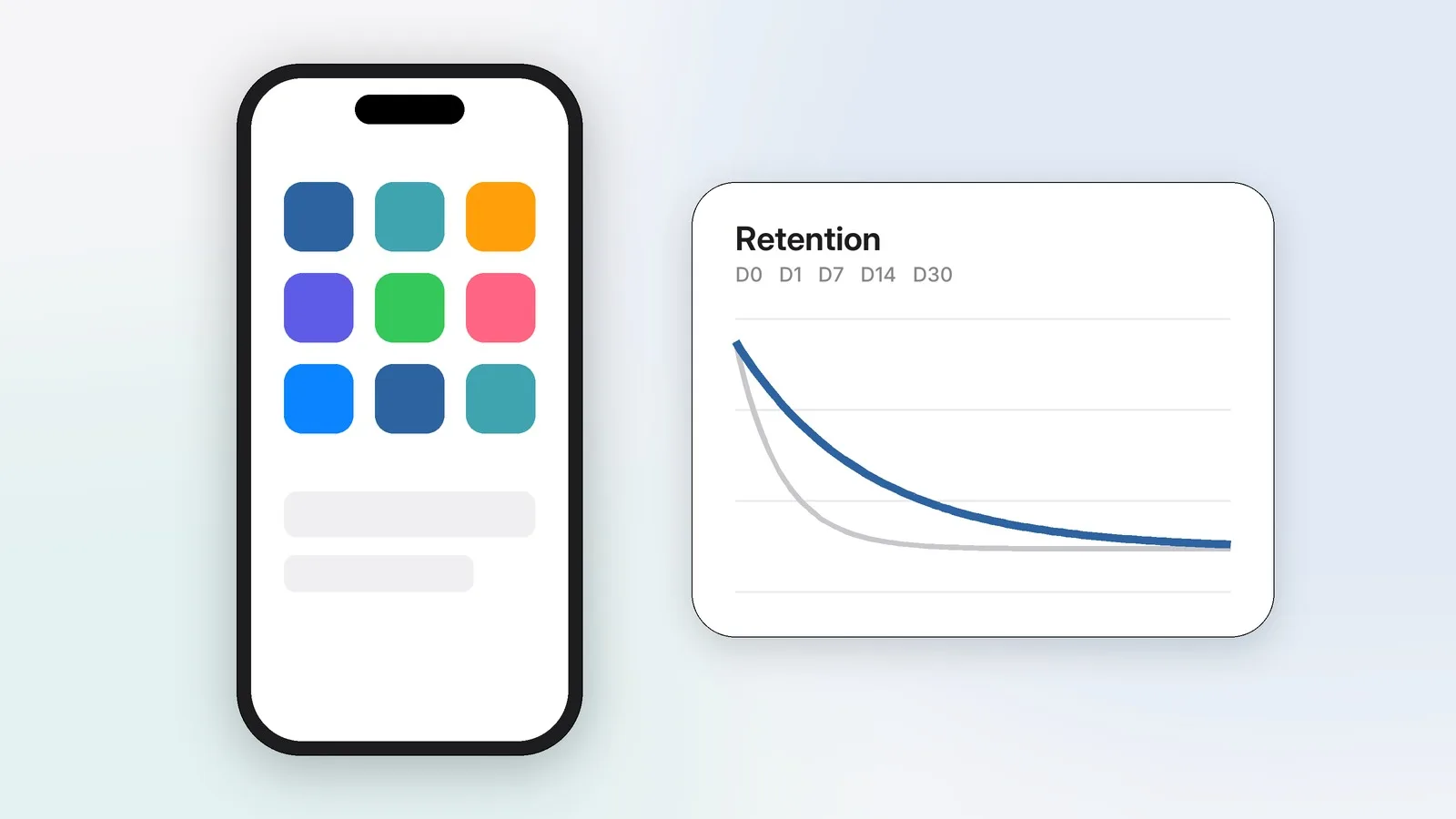
An install is a cheap event to fake and an easy event to buy in bulk from low-intent placements. A campaign can deliver a beautiful CPI while most users churn on day one. Always pair CPI with quality guardrails — for example minimum day-1 and day-7 retention, or a minimum rate of a key in-app event — and agree up front what happens to installs that fail those checks.
What is CPA (cost per action)?
CPA pays for a specific action after the install or click: a purchase, a subscription, a trial start, a level reached, a booking. Because the action sits deeper in the funnel, it is closer to revenue and harder to inflate with low-quality traffic.
CPA = media spend ÷ completed actions.
When CPA works well
- You have one event that clearly signals value — a first purchase or a paid subscription.
- That event happens often enough for optimization to learn from it. If only a handful of users complete it each day, algorithms struggle and prices climb.
- Your tracking sends that event back to the media partner quickly and consistently (postbacks or server-to-server).
What to watch
Define the action precisely: which event name, within which attribution window, counted once per user or every time, and whether refunds or cancellations reverse it. Ambiguity here is the most common source of billing disputes.
What is CPR (cost per registration)?
CPR pays for each completed registration or sign-up. It sits between CPI and CPA: deeper than an install, but earlier than a purchase. It is common for lead generation, marketplaces, SaaS trials and any product where an account is the real start of the relationship.
When CPR works well
- Account creation is the key step and later monetization happens over weeks or months.
- You can verify registrations — email confirmation, phone verification or a completed profile.
What to watch
Registrations can be faked with scripts or produced by users who will never return. Pay only on verified registrations, track how many go on to activate, and reject sources whose sign-ups never do anything.
What is CPD (cost per deposit)?
CPD pays when a new user makes their first deposit — the moment money first moves in a fintech, trading or wallet product. It is the deepest of the four models and the closest proxy for revenue in deposit-driven businesses.
When CPD works well
- Your product earns from deposited balances, trading activity or transactions.
- Onboarding includes identity verification, so a deposit represents a real, verified customer.
- You operate in markets and categories where the product can be advertised legally and in line with platform policies.
What to watch
Conversion windows are often longer — verification and funding can take days — so reporting lags and optimization is slower. Agree on a minimum deposit amount, how long after the click a deposit still counts, and how chargebacks are handled.
How to choose the right model
There is no universally best model. The right one is the deepest event that you can track reliably, that happens often enough to optimize, and that is tied to value for your business. Three questions narrow it down quickly:
- What can you measure end to end? If a purchase is not passed back to the media partner, you cannot pay on it. Fix measurement first or choose an earlier event.
- How frequent is the event? Rare events produce volatile prices and slow learning. Many teams start on CPI or CPR to build volume, then move toward CPA or CPD as signal improves.
- What is the event worth to you? Every model only makes sense against a target derived from your own margins.
Work backwards from unit economics
Set your target price from what each event is worth, not from an industry average. A simple, illustrative example for an app:
- Average revenue per paying user over 90 days: $60
- Share of installs that become paying users: 5%
- Value of one install: $60 × 5% = $3.00
- Target return on ad spend at 90 days: 120%
- Maximum CPI: $3.00 ÷ 1.2 = $2.50
The same logic works for any model: the value of the event, divided by the return you need. Our campaign planner lets you run this calculation with your own numbers in a few seconds.
Price the event, then protect the event. A target without quality guardrails only tells a partner how cheaply they need to deliver — not what they need to deliver.
Setting targets and guardrails that scale
- Start with a test budget. Run a controlled test across a few sources and formats before committing scale budgets. You are buying information as much as users.
- Price by geography. Users in different markets have very different values. Set separate targets, or at least separate tiers, for each country group.
- Add quality KPIs to the agreement. Retention, activation rate, deposit-to-registration ratio — whatever predicts value for you.
- Insist on source-level reporting. Averages hide bad sources. Transparent reporting by source, placement and creative is what makes optimization possible.
- Filter invalid traffic before you pay for it. Our guide to ad fraud prevention covers the warning signs to monitor.
Common mistakes to avoid
- Choosing the deepest possible event before tracking can support it.
- Optimizing CPI in isolation and discovering the churn a month later.
- Using one blended target for every market.
- Leaving the conversion definition vague in the insertion order.
- Scaling a source before it has proven quality, not just price.
Frequently asked questions
Is CPA better than CPI?
Not automatically. CPA is closer to revenue and harder to inflate, but it needs reliable event tracking and enough volume to optimize. Many advertisers start on CPI with retention guardrails and move to CPA once they have the data to support it.
What is a good CPI?
A good CPI is one that is lower than the value of an install for your app. Benchmarks vary widely by country, platform, category and season, so the most useful target comes from your own revenue per install and the return you need.
Can we switch pricing models during a campaign?
Yes. A common path is CPI → CPR or CPA → CPD as measurement matures and the deeper event becomes frequent enough to optimize. Plan the switch with your partner so that targets and attribution windows change together.
Which pricing model carries the least risk for the advertiser?
The deeper the event, the more risk shifts from the advertiser to the media partner. CPA and CPD protect you best — provided the event is clearly defined, verified and tracked.
The bottom line
CPI, CPA, CPR and CPD are tools for different stages of the same journey. Start with an event you can measure and optimize, price it from your own unit economics, protect it with quality guardrails, and move deeper in the funnel as your data improves.
If you would like a second opinion on which model fits your funnel, send us a campaign brief — a SkyPlay Media strategist will recommend a pricing model, a channel mix and a test plan built around your KPIs.
SkyPlay Media is a results-driven performance marketing and ad-tech company helping advertisers and app developers grow through data-driven user acquisition and retention.
Let’s build growth, powered by performance.
Talk to a specialist about your goals — we reply within one business day.